What Happened to Grind King?! | Brand Breakdowns
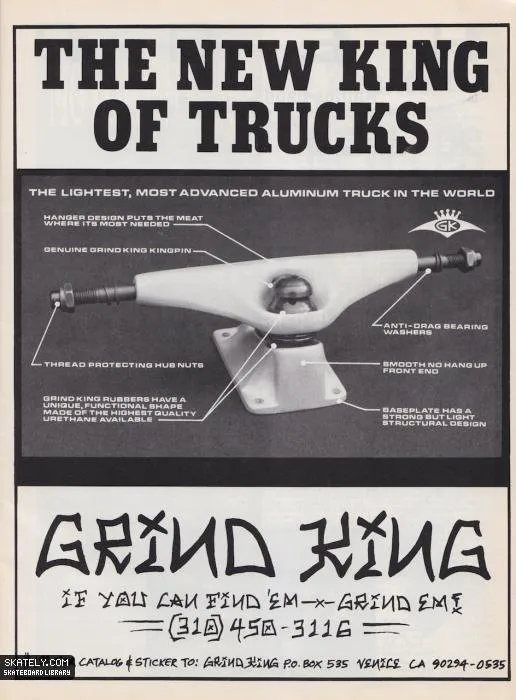
Short version: Grind King started in 1988, when skater Donald Cassel started selling a hardened “grinding kingpin” with a rounded Allen head for $12.95. His first two trucks (1991 and early 1992) flopped, but the third, the GK3, sold because it was light. The company grew into Darkhorse Distribution, peaked with the AXL and AXL II trucks in the 2000s, and went quiet around 2010: team riders left in 2008 and the last blog post is from July 2010.
What a lot of people didn’t know, me included, is that Grind King started out as just a kingpin.
A $12.95 kingpin
In 1988, Donald Cassel was 28. He was a skater working in construction on his way to becoming a land developer, and he had an idea he’d been riding since 1986: a hardened kingpin, flipped over, with a rounded, low-profile Allen head. Regular kingpins got ground down until you couldn’t adjust them, or snapped. His wouldn’t.
“So since what I created was a ‘grinding kingpin’, I shortened the two words to name my product ‘Grind King’.”
He debuted it at the ASR trade show. A little bored, he wandered around the show with a few bolts in his hand, ran into VK Sports, and they ordered a thousand on the spot. He ended up hand-packaging bolts to fill orders, and it grew into a full-time business. He never went into land development.
They weren’t cheap.
“The Grind King Bolts were expensive to make. I used the best steel alloy I could find. Originally the washer was machined, and the bolt was partly machined and partly cold-headed. Cold-heading is the process of forming something to shape under extreme pressure. I sold the kits for like $12.95, although people warned me I wouldn’t be able to do it. Regular kingpins were selling for less than a couple bucks.”
Imagine paying that for an accessory in 1988. The LA Times put regular hardware-store kingpins at about 60 cents.
There were problems, though. Since it was a third-party part, it didn’t fit every truck perfectly. And counterfeits were a big deal: knockoffs made from the wrong grade of steel, copying the design without the standards. Cassel would get broken fakes mailed back to him with angry notes, as if they were his.
So what did he do? He made his own truck.
Two trucks that bombed
He started with clay models in 1990, and the first Grind King truck came out in September 1991. It didn’t sell well.
“I started out with a pretty different-looking truck. The kingpin, the funky curved baseplate. It was only mildly successful.”
Funky how? It had a hollow, curved baseplate, and the axles slipped almost immediately.
So the second model came out only a few months later, in early 1992. And it was even weirder.
“It was really a wild one! I had all these innovations; I went overboard. It had a floating axle that would slide back and forth, and it had the threads on the inside instead of on the outside. Allen screws went in the end to hold the wheels on, and it had these funky bushings with, like, corrugation. It was either ahead of its time, or out in left field too far!”
It bombed too. It was just too different. And right around then, basically every truck brand switched to the new hole pattern, and his curved baseplates didn’t leave room to drill the extra holes. He’d also just made a pile of inserts meant to protect mounting bolts from noseslides, and the new hole pattern made those pointless too.
“Basically I had all this product that had become obsolete overnight.”
The GK3 finally works
He kept at it, and the third version, the GK3 in September 1992, was finally a hit.
“I went back to a more conventional design. People dug ’em because they were really light. I think as wild as skaters are portrayed, they’re really conservative in their buying habits. They don’t want to stray too far from the norm.”
Not every pro was sold. One told him they were too light. Cassel tried to explain that light was better. “No,” the pro said, “I’m used to heavy. I want heavy.” If you got to pro level on heavy trucks, you want heavy trucks. To be fair, the lightness did make them a little weak.
By 1992 the company made around $100,000 in profit, according to Cassel, with sales of about $726,000 in hardware and $121,000 in clothing. Grind King had started selling clothes, and he started Haz-Mat skateboards and signed Eric Dressen, with Gershon Mosley and Jimmie Young on the team. I couldn’t find much about it, and it doesn’t seem related to the Haz-Mat that came out more recently. There was a Haz-Mat snowboard line around then too, and it got ripped off as well: the Japanese distributor started its own company called Haz-Mate.
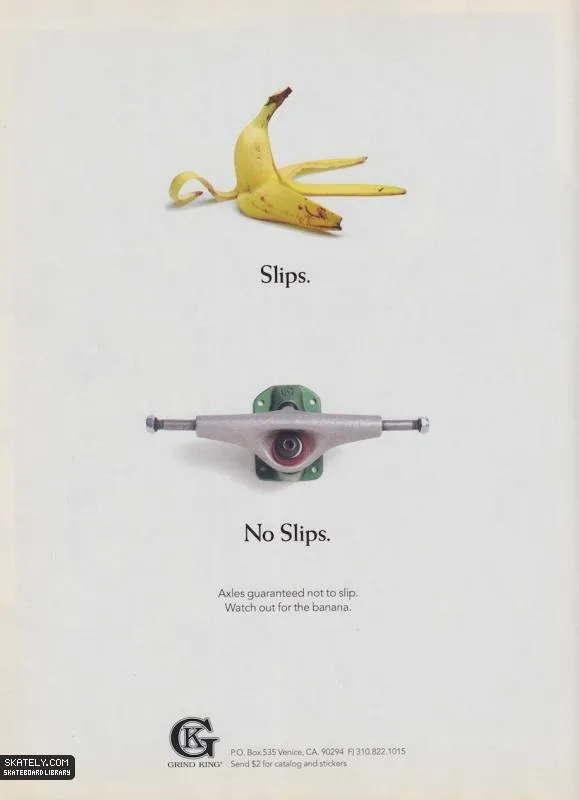
Part of why the trucks worked was the advertising. Cassel worked with a marketing guy to advertise the product itself, like a banana peel next to the truck: “Slips. No slips.” Most brands just showed their pro team and implied the product was good.
Bridge Bolts, Darkhorse and too many brands
The next hardware idea was Bridge Bolts: U-shaped bolts that replaced two regular mounting bolts each, so you needed fewer parts and one tool. Cassel told the LA Times they started selling more than the Grind Kings.
Then came a lot of brands through the 90s: Society Skateboards, Belladonna women’s clothing, Grind Queen apparel, Underdog shoes, a partnership with his brother in Von Dutch, and Termite, kid-sized boards with fewer plies. There was even the Kre-per “anti truck,” heavy, glow in the dark, shaped like a spider web with a skull on it. I thought those were a gimmick at the time and had no idea they were Grind Kings.
All of it went under an umbrella company, Darkhorse Distribution. He picked the name because he wasn’t really part of the skate industry “club.” But a news article from that period says he’d overextended and was still paying off debt, and that he wished he’d stayed smaller.
The trucks keep getting better
Meanwhile the trucks kept improving:
- 1994, GK4: more strength.
- 1996, GK5: a minor change, removing the center rib under the baseplate. The GK5 high was a great seller.
- 1999, GK6: completely reworked, with a new kingpin and bushings and a beefier but lighter axle.
- Around 2002, GK-AXL: a premium truck. The axle bar was flattened, bent and punched with holes to save weight. That’s really hard to tool, because you can’t cast at an angle like a normal axle, and they solved it with great difficulty without ever saying how. It also had a locking bolt under the baseplate so you could swap bushings without taking the truck off. They went to extreme lengths to show off the anti-slip axle, even though slipping axles were basically solved by then.
- 2004, GK7: a redesigned hanger, a kingpin sleeve nut for stability, a lower kingpin and new bushings. They also launched Thunderbird longboard trucks.
- AXL II: the peak. Lighter and stronger than the AXL, hard-top bushings with no break-in period, concave bushing seats where the bushings meet in the middle, a smaller kingpin head, a radial hanger curved for better grind control and a stronger baseplate redesigned for noseslides.
Who’s really innovating in trucks today? There haven’t been many steps forward since then.
Not everything was great. There was a Velvet series, and a Dub series with rims, which I bought.
So what happened to Grind King?
In 2008, Joey Brezinski and Danny Supa left the team. I couldn’t find any more information than that. The company blog’s last post is from July 26, 2010, and people in the comments asked what happened without an answer. The website went down too. I tried to reach Don Cassel and didn’t hear back.
That’s where things stood when I made this video. But there’s a postscript: Grind King got in touch with me afterward and came back with a new truck. I announced it in The Return of Grind King!