Jamie Thomas - From Stealing Stereos to Trolling Rad Rat
Short version: Jamie Thomas grew up in Alabama, got in trouble as a teenager, moved to San Francisco in 1992 and lived on the street at Embarcadero. He turned pro for Experience, had the ender in Toy Machine’s Welcome to Hell, started Zero in 1996, attempted the 18-foot-8 Leap of Faith in 1997 and launched Fallen in 2003. Fallen eventually closed, but Zero is still independent and he’s still filming parts.
Jamie Thomas is a professional skateboarder. And I don’t just mean he’s pro. I mean he’s professional. He’s motivated, he takes things seriously and he puts effort into his businesses. He’s also a guy I’ve personally fought with in the past. Let’s take a look at his career.
Alabama and getting in trouble
He grew up mostly in Alabama. He started skating in the mid 80s, but it was a long time before he met other skaters and actually learned real tricks. He skated for a few years and really loved it, but he also loved being kind of a turd.
When Jamie was in 9th grade, he and his friends would break into cars and steal stuff. It escalated until they were ripping off stereos and selling them for cash, which they spent on cigarettes and alcohol. Then the guy he was selling to got busted and turned Jamie in. He spent a couple days in juvie, but since it was a first offense, he got off with community service.
That didn’t really stop him. He quit breaking into cars, but he was still heavily into drinking and partying. One day that summer he was smoking a cigarette and realized that, just like that cigarette, his life was going to burn away and be over. That epiphany got him to start getting his life together, or at least to start taking skating seriously. He later dropped out of school and worked a fast food job to save up for contests.
While he was coming up in the NSA contest circuit, he picked up a couple of sponsors. He worked at a skate shop, made some contacts at REAL, and they flowed him boards. He sent them sponsor-me tapes every single month: him skating a driveway or a local mini ramp. File those tapes away for a bit. One of them comes back later.
If you want more detail on this part of his life, watch his Nine Club interview. He goes deep on all of it.
Homeless at EMB
In 92, he decided to move to California with a couple of friends.
“But Sean and I, being from Alabama, would have rather lived on the streets of San Francisco than in our homes in Alabama. Alabama’s the worst.”
When he got there, he didn’t have a plan or anyone waiting to help him out, so he lived on the streets for months. He actually lived at Embarcadero for a while, and it really sucked. He tells a lot of stories about hustling for food and being a board broker, selling boards for people and taking a cut. The worst one is this:
“Okay, when you skate you get scabs. We were homeless and didn’t shower that often so me and Sean both got staph infections which is like a skin disease and at the same time I also got strep throat from my body just getting worn down. So by this time we were spare changing our meals and eating at homeless shelters. Eventually, we went to the free clinic. We got a penicillin shot and the doctor told me the only way I was gonna get off the street was male prostitution. Meanwhile, we felt hated by the locals and I remember asking myself, ‘What the hell am I doing here?’”
Eventually he made a friend, moved in with him, could shower regularly and got a job selling shoes, something he’d do at a much bigger level later. His real break came when he went pro for a brand called Experience.
I hadn’t heard of Experience before, but it was the early 90s. Everyone was starting a company, and most of them failed. You can guess how it went: missed checks, sketchy management. But it was worse than most.
“The dude Roger that owned it was, by definition, a slimeball. He’d scam anyone: team riders, magazines, manufacturers. It wasn’t long until he burned everyone and things just started to fall apart.”
He made a sponsor-me video for Black Label, but took a detour to a brand called Invisible instead. That didn’t work out for personality reasons with another guy there. He went without a sponsor for a while.
Toy Machine and Welcome to Hell
Then there was a mass exodus at Toy Machine and everyone left. One of the guys Ed Templeton called to replace them was Jamie, who was happy to join. He was a good pick for any team. He’d just had his first TransWorld cover, a kickflip over a massive roof gap. It’s a sequence with a model photo in the middle for some reason. They must have loved that sequence to put that monstrosity together.
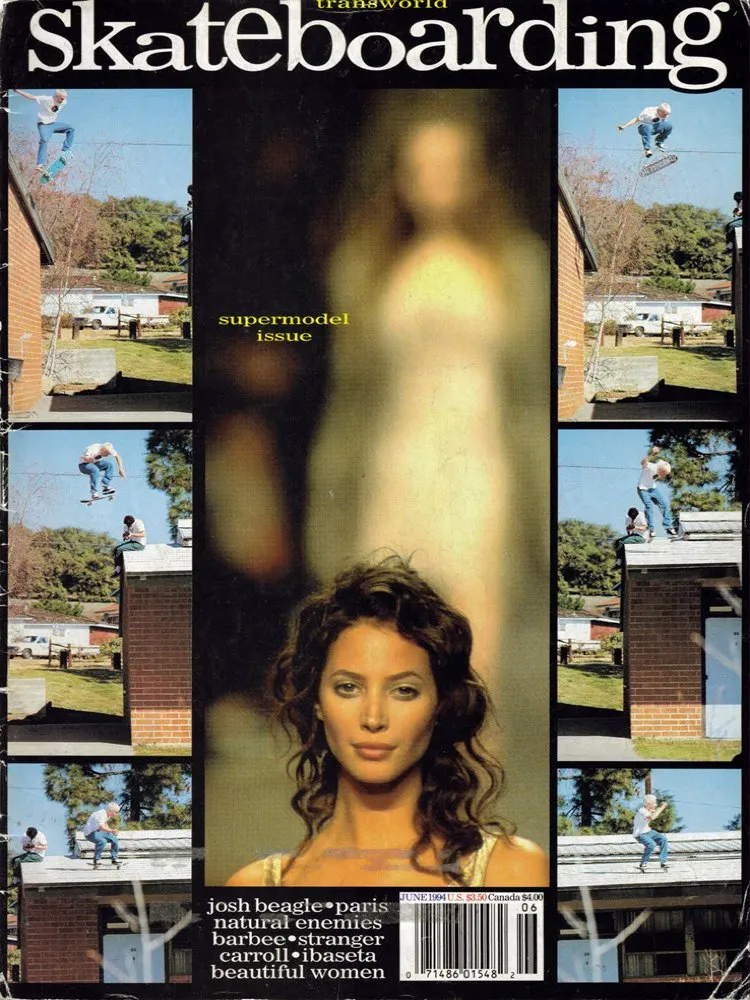
Jamie thrived on Toy Machine. He was in two of their videos, Heavy Metal and Welcome to Hell. Welcome to Hell is one of the most iconic 90s skate videos, still a lot of people’s favorite, and Jamie has the ender.
He did something interesting with that part. It was the first video he worked on with computer editing software. He’d been editing his own parts tape to tape, and it’s hard to really direct something that way. You just mess with it until it looks alright. Here he could get serious. He picked his song first. It starts with a long, slow section, so he planned a line across the Brooklyn Banks that ends on a rail nobody had done before. Then the music picks up and he cuts into quicker clips. I hadn’t noticed it watching before, but the whole thing was planned. That’s how seriously he took everything.
You might notice he was bald in his clips. I always knew that, but I didn’t know he’d shaved his eyebrows off too, basically for no reason. He was scared of how he’d look, so he decided to conquer the fear and shave them. That story comes from his 1995 Pro Spotlight in TransWorld, which is a pretty great story on its own.
The one-day Pro Spotlight
He was 20, and he shot his whole Spotlight in one day. Most skaters took about six weeks back then.
He did his first trick at 10:00, a 50-50 and a 180 nosegrind on a handrail. They went to a pool and got a frontside 5-0 in about 15 minutes. Then an apartment gap, then a three-block for a benihana. There’s an alley-oop 180 over a rail, a tre flip over a chain and a heelflip over a roof gap. There are plenty of stories about getting kicked out and dodging security, but at one spot the cops showed up and just told him he should wear pads. He closed it out with a frontside noseslide and a backside nosegrind.
None of that is crazy by today’s standards. He’s nosesliding a three-set. But for the time, all of it in one day is pretty awesome.
What stood out in that interview is how seriously he took everything. Unlike when he was a kid, he went vegetarian and didn’t drink, simply to be as healthy as possible so he could skate better. He was the responsible one on the team, always trying to motivate people.
He also had a career goal that he completely failed at:
“I want to have a short and hard-hitting career.”
Twenty-plus years later he’s still going. He got the hard-hitting part right, though, especially at the Leap of Faith. But that comes after Zero.
Starting Zero
He almost stumbled into Zero. He just wanted to make clothes with a more rock style. But some of the people he was giving shirts to had lost their board sponsors, and Jamie started tossing around the idea of making boards for real.
“I started Zero as a little t-shirt company with hopes of it becoming something bigger. We sold a few shirts here and there and I asked Tod if he was cool with me making a few boards. He said yeah and we made a few small runs. They sold, but it was obvious if it was gonna happen, we were gonna have to get focused and go for it.
So Tod asked me to write a business plan and if it was convincing enough, he’d back it. I had no idea what I was doing, but I wrote a few pages breaking down why I wanted to start a company and what was going to be the mission and gave it to Tod. After a week or so, he told me he was down. So I started building a team and Matt Mumford was the first pro. Then I told Ed I was leaving Toy… that was hard.
The basic mission behind Zero was to put together a group of like-minded people with heart and a passion for skateboarding and make it happen on a shoestring budget. I wanted the aesthetic to be simple with a rock & roll vibe.”
The Leap of Faith
Leaving a successful company to gamble on Zero was the original leap of faith. That’s what the caption on this ad is about. But the name stuck to the gap, and the story of how he came to try it is strange.
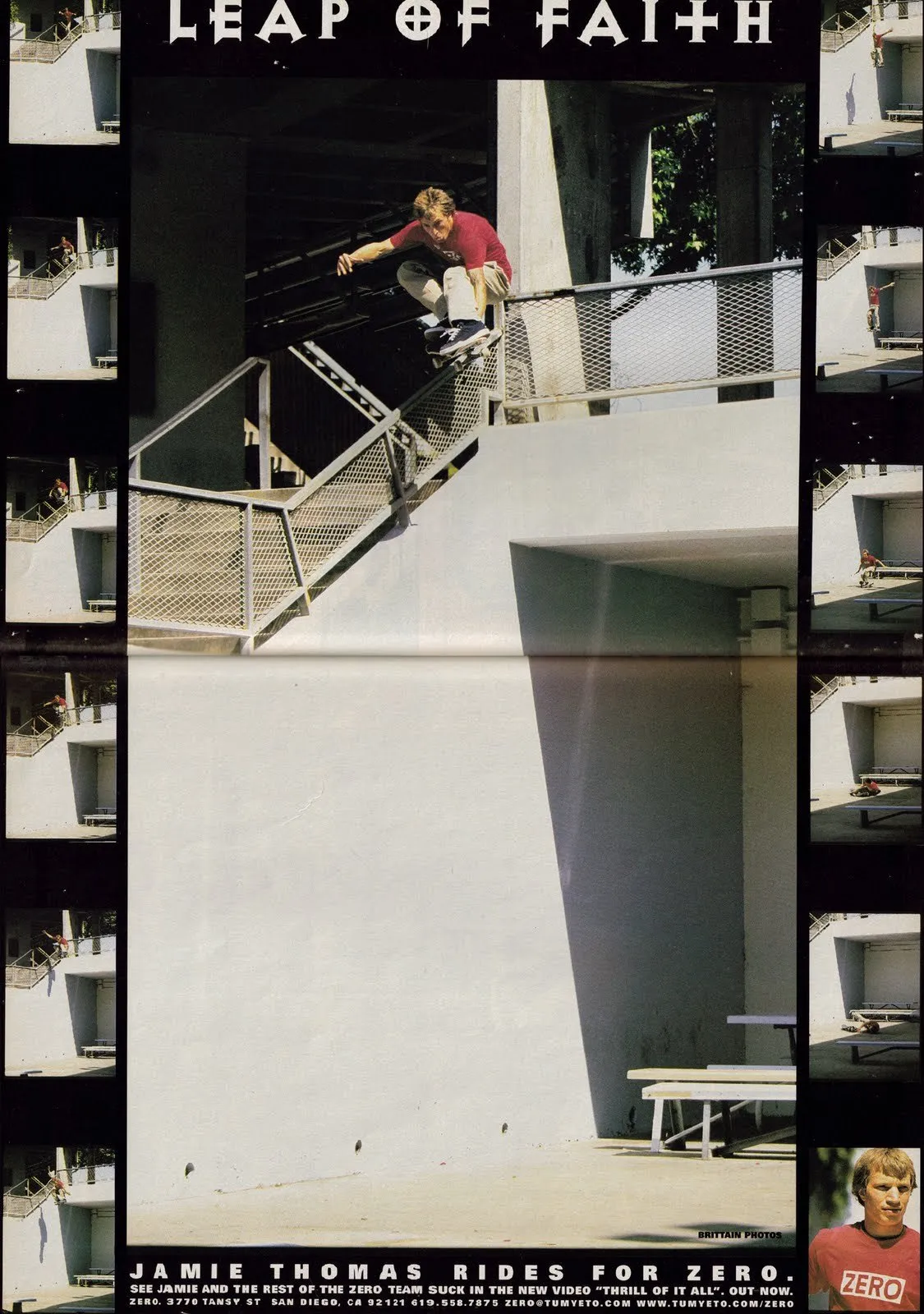
Jamie never told people what he was planning, because he didn’t want their opinions holding him back. He was one of the best in the world, and he wasn’t going to be limited by what other people thought was possible. In 1997 he took a couple of people to the spot just to scope it out. He didn’t say he wanted to ollie it. But when he rolled up, there was writing on the rail: “Jamie M. Thomas gap.” Nobody knew he wanted to try it. His guess is that someone from the school thought it would be perfect for him and wrote it there, prophetically.
He did eventually try it. It’s 18 feet, 8 inches, basically a two-story building. He did a melon grab and hit the ground so hard it threw him off. He didn’t expect just trying it to become such a big deal.
“I think some of the infamy behind the Leap Of Faith is because that dude Richard King tried it and broke his legs. Comparing it to what people are doing now, I think some of the stuff Sheckler has kickflipped seems to be almost as big as the Leap. I don’t know if it’d ever be common, but I think if it was still around, Sheckler could do it.”
“Chief”
So Jamie was one of the best skaters in the world, and he was also Zero’s owner and team manager. He coordinated the skate missions and kept everyone motivated, and that’s how he got his nickname.
“I don’t know exactly how it came about but one day in ’97 or 98, I picked up Ellington, Elissa and Greco to go skating and they were all excited with this new nickname they had for me. They called me ‘Chief’ every chance they got and that’s the way it was from then on.”
People have called him that ever since. And the work ethic paid off: his Misled Youth part in 1999 got video part of the year.
The tape Baker almost used
Remember those monthly sponsor-me tapes? One of them had a joke line he filmed as a teenager, the kind of thing you’d never want anyone to see. He says he doesn’t know if anyone at REAL watched them, but someone did. The Baker guys found the tape and thought it would be funny to put that line after the credits of their video, Baker 2G, I think.
Luckily Jamie had a lawyer friend by then, from getting a shoe contract looked over, so he asked what to do. He had nothing to do with Baker and never gave permission. The lawyer said they couldn’t use the footage, and any copies would have to be recalled.
So Jamie called Baker’s business manager and told him the video couldn’t go out with it. It was already finished and due at duplication that day. Luckily for Jamie, it was already delayed by music rights problems, so they pulled the clip and replaced it with a black screen that says “skateboarding has gotten so serious that this screen has to be black.”
I couldn’t find that black screen. The copy of Baker 2G I found online doesn’t have it, but I doubt anyone wanted to upload two minutes of nothing. It’s also possible it was a different video, but that’s the one he mentioned. If you know exactly where it is, tell me.
Can you imagine? Something stupid you filmed as a teenager almost goes out in a huge video from a rival company. Jamie thinks they just thought it was funny. But they were a rival brand, and if they’d wanted to make him look bad, that would have done it. Who knows.
Fallen, King of the Road and saying no to buyouts
The next few years went really well. He won TransWorld’s Skater of the Year in 2002, launched Fallen in 2003 and led Zero to three straight wins in Thrasher’s King of the Road. Zero’s fourth video came out in 2005, and Ernst & Young named him an entrepreneur of the year. He got a lot of offers to buy his companies, and financially, selling would have been a good move. But he says:
“I never got in this to get rich and all of the people that were offering to buy the brands were investment bankers. I just couldn’t imagine something that we cared about so much about being owned by someone who cared so little.”
Respectable. But then the 2008 recession hit. Nobody had money, oil prices were crazy, and that hit shoes hard. More on that in a second. Fallen still put out a video in 2008.
The time Jamie Thomas and I had a fight
When Ride the Sky came out, Jamie and I had a bit of a fight.
I bought it on DVD and thought it was too generic: a bunch of parts of people doing handrails, maybe a little bigger or more tech than before, but nothing original. So I tore it apart and said it wasn’t worth buying. I did like Jamie’s part, because there was some legitimately interesting stuff in it. But I told people not to buy it. I had a different YouTube channel back then with something like 30,000 subscribers, so that went out to a lot of people.
Jamie saw it and made a comment on a forum about how “the king of the nerds” didn’t like his video, and a bunch of people flooded my comments to tell me how horrible I was.
I was really offended. Not liking his video was one thing, but a personal insult made me angry. I made a follow-up video about what happened.
Then Jamie sent me a personal message on YouTube, and it was the most respectful, polite thing I’d ever gotten. Here I was, a 20-year-old kid complaining about his video online, and he went out of his way to clear the air and apologize. I don’t have the message anymore, but he said a lot of people put two years of work into that video, and seeing me dismiss it and tell people not to buy it frustrated him, so he lashed out. But he was sorry.
That blew me away. He didn’t owe me anything. He didn’t even say anything that bad. It’s not like I didn’t know I was a nerd. But it made me realize I was misusing my “power” on YouTube.
I’d made a very personal review. That wasn’t the style of skating I liked, so I told everyone it sucked. But people weren’t watching my channel because they liked what I liked. They were watching for trick tips. I told a big group of people who might have loved the video not to buy it, just because there was no Rodney Mullen or PJ Ladd on the team. That wasn’t fair.
I was going to update the review and the follow-up, but a copyright complaint took them both down, so I left it. I still walked away with a lot of respect for him.
He says this about that period, not about me specifically:
“The message board battle catapulted me into the information age. I’d never dealt with the hostile environment of the message board community and I didn’t know the first thing about how it worked. I spent about 8 hours a day on the messageboard for over a month. I wouldn’t go to sleep at night until every claim was addressed and no one else was posting. It was like I spent a month at a self-realization temple dealing with a whole lot of hate and false rumors. I think it was more comparable to the way I felt upon arriving at EMB. Obviously more extreme, but similarly it taught me a great deal of humility.”
Why Fallen failed
I don’t think I had any part in Fallen failing. They had plenty of other problems. One year their factory burned down and they lost a whole season of shoes. They lost another to mold, which can happen when shoes ship from China by boat in the wrong conditions; they arrive moldy and never come clean. Oil prices drove up materials, the factories that met their prices couldn’t meet their quality, so Fallen shoes got worse while costing more. Nike and the big brands were moving into skateboarding, and it was tough for an independent company to stabilize. So they partnered with Dwindle, which already had Globe.
“Shutting Black Box down was tough; I had to say sorry to a lot of people. Fallen grew really fast and shrank at the same speed. When any brand has that type of trajectory, it’s hard to make it out alive. The hardest part is the toll it had on of all of my work relationships. It’s been like going through a divorce. I obviously wanted to keep Zero & Fallen going, so I had to try and find a home where they would be stable in hopes that they could start growing again. Dwindle has been exactly that. I miss the camaraderie with everyone at Black Box, but I don’t miss the responsibility that goes along with running a distribution.”
Fallen still failed. Sales weren’t there, and they stopped hitting the factory minimums, so they called it quits. Luckily, Zero survived.
“We were at Dwindle for two-and-a-half years and with where the industry is and how small Zero is these days, it made sense for us to be independent. The support we received from Dwindle was awesome, it helped us regroup and stabilize the brand, but I feel we lost touch with some of the retailers and elements of the business that need personal attention. We have a really small, but solid, crew now and everyone weighs in on everything we do; it feels the way it did when we were first getting started.”
That’s encouraging. He talks about a smaller company being faster and more responsive. More corporate layers were limiting, even though the people he worked with were great.
Where is Jamie Thomas now?
When I made the video, Zero had a new one coming called Damn It All, and Jamie was in it. He said:
“Nah, this won’t be my last part. I don’t think there’s any benefit of setting a finish line. I’m enjoying the journey and I intend to keep it going ’til I got nothing left to give.”
For shoes, he joined STRAYE. He has an ownership stake with Chad Muska, but he isn’t running it. Angel Cabada, the founder of KR3W and Supra, runs it, and the idea is that everything is under $60.
He also started Garage Days Collection, a site where he and now some other pros sell off their old stock: old Zero decks, shoes, posters, anything you can think of. Don’t expect original retail prices, but if you’re a collector, it’s worth a look.