Ronnie Creager - Easily Manipulated?
Short version: Ronnie Creager, born in 1974 in Orange, California, turned pro for Foundation in the early 90s and pioneered switch and nollie tricks in Super Conductor Super Collider. Foundation fired him right after Rodney Mullen offered him a spot at World Industries, and he rode for Blind for about 20 years until they split in March 2014. Since then he’s run his own board brand, High School Dropout, and sells boards at ronniecreager.com.
Ronnie Creager is a constant in skateboarding. The Skateboard Mag put it well when they said he’s just always been Ronnie. He never had a tech-to-hesh transformation, rehab, retirements and comebacks. He never had a handrail phase or a marketing makeover. He’s just been the same guy, getting better and better. His focus has always been skateboarding, and even though that may have come back to bite him as he’s gotten older, there’s still something to admire about it. Let’s take a closer look at his career.
Growing up skating in Orange
Ronnie was born in Orange, California in 1974 and started skating at 3 or 4. His first board had a Bruce Lee graphic. He borrowed his sister’s board a lot, but that was his first one.
As a kid he played baseball and soccer, but nothing grabbed him like skateboarding:
“Skateboarding was always for me. I set the standards. I rode when I wanted and rested when I needed. I liked the feeling of being my own coach. Plus, I never had to run laps or do exercises for an hour. All those warm, sunny days wasting away trying to beat another team just made me want to skate more.”
I agree with this 100%. I used to skate a park in Romeo, Michigan right next to a school, and I’d watch the football team getting screamed at by their coach while I skated. We were both getting sun and exercise, but there was no doubt who was enjoying it more. Would you rather run laps or play a game of SKATE?
Ronnie only had a couple of jobs growing up: he delivered newspapers and worked at a skate shop for store credit. In a lot of early interviews he admits he doesn’t have much work experience, and he never had a great answer for what he’d do after skating. The Skateboard Mag described him this way:
“He is essentially a big kid. Not in a bad way, but in the way that most every nine-to-fiver in the world is secretly envious of. Actually, in a way that maybe most everyone is envious of. He’s a naturally casual, consistent, mellow big kid with impeccable talent on a skateboard. When he’s not skating, he’s still playing. Golf, kayaking, shooting bb guns, video games, Frisbee, baseball, darts, ping pong, riding motor bikes—you name it.”
Foundation and Super Conductor
He never really had to work, because he was so good at skating. He got flowed by Powell as a kid, but his first real sponsors were the shop Hot Skates and then Foundation. He went pro for Foundation at 17 or 18, depending on which interview you believe. He was also on Etnies, where he starred in their first commercial.
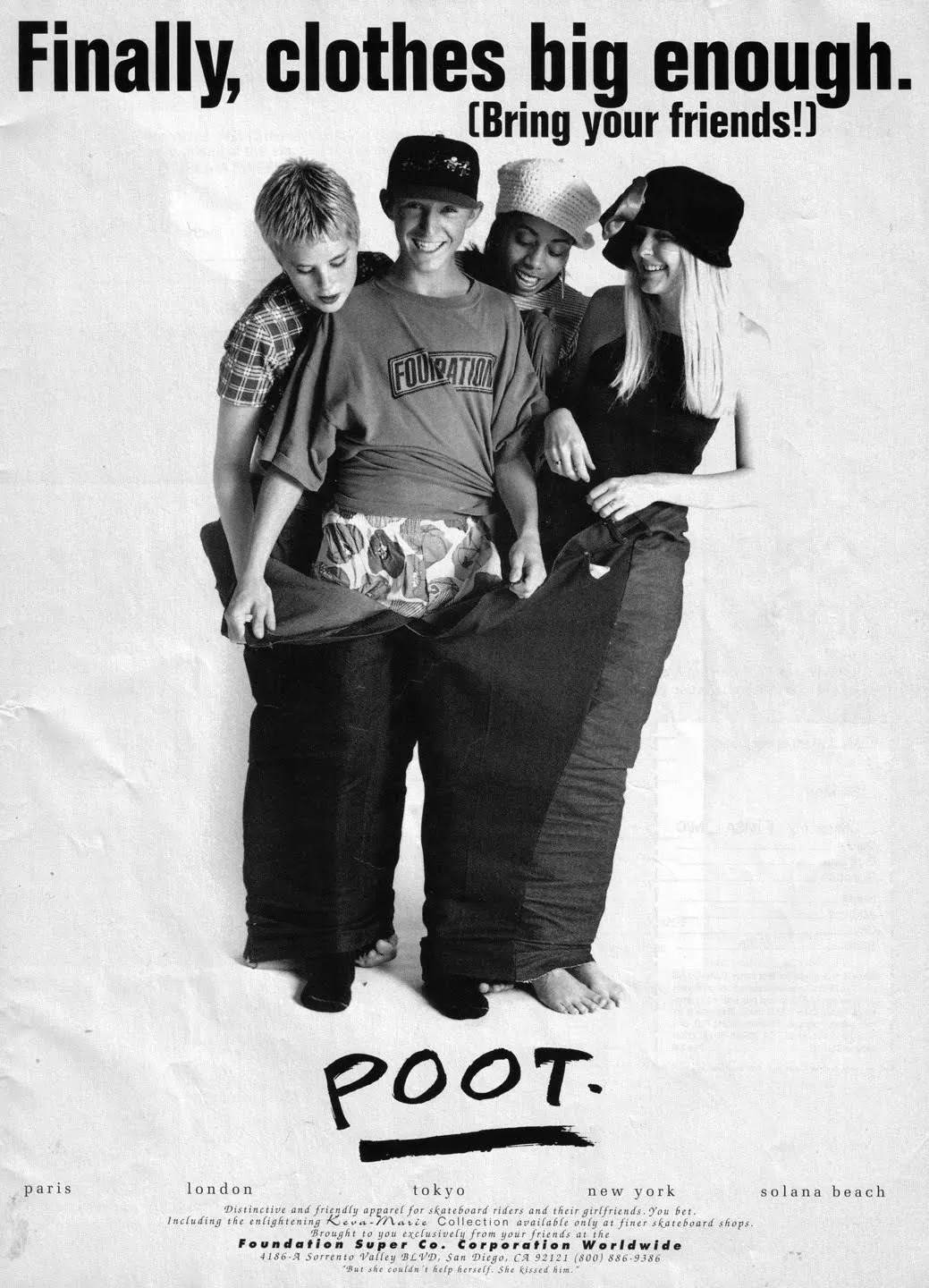
His first Foundation ad was actually for their offshoot brand, Poot. Is there anything more 90s? They made unbelievably huge pants to advertise their already ridiculously big pants.
His early footage was really impressive for a new name. He’s got cutting-edge tricks like a switch 360 flip and a backside noseblunt, and for the time it was stylish, clean and fast.
In the next year’s video, Super Conductor Super Collider, he goes a lot further with switch: a switch front blunt kickflip out, a switch flip 5-0 and all kinds of nollie stuff. He later said a lot of tricks felt easier to him switch, but there’s no denying he’s a pioneer for a lot of that stuff.
From the start, Ronnie had little interest in the business side. He was in attack ads against Steve Rocco, and he says he didn’t really know or care what was going on in the industry. He didn’t care about building or managing the team. He was just there to skate.
“We were just skating and filming back then, man. That’s all we did and we loved it, too. It was fun! Because I don’t think you ever really feel pressure at that age. There were never any struggles… I don’t even think we knew that we were filming for a video at that point. Super Conductor basically came from the realization of everyone having all this footage. We’d all been filming so much that we had all this stuff, might as well throw it in an edit and put it out.”
He cared so little that he didn’t realize he was stepping on toes with that part. Someone else did that switch 360 flip at that spot first, and he took a song from Justin Girard’s part in 1281. He didn’t really notice or think about it.
Trick stealing is a weird idea to me, but that’s because I’ve never skated at a pro level. If I film a crooked grind on a box at the skatepark, nobody cares. But if you’re a pro and you took a new trick to a spot nobody had done it at, it’s yours. If someone else does the exact same thing there, it’s almost like they’re claiming it, or claiming they did it better.
“I don’t think I knew that it could even be taken that way. Rick definitely did the switch 360 flip there first, which probably inspired me on some level. He’s always been one of my favorite skaters ever but I didn’t mean anything by that at all.”
Why Ronnie Creager got kicked off Foundation
Despite being one of Foundation’s biggest names and putting out a couple of great parts, he suddenly found himself on the street. He doesn’t really know why. Here’s what happened.
While things were going smoothly at Foundation, he started getting calls from Rodney Mullen, saying there’d be room for him at World Industries if he ever needed it. Almost immediately after that, Foundation fired him.
Ronnie has given a couple of explanations. One is that someone found out he’d been talking to Rodney and fired him for it. Possible, but a little weird.
The other is his theory that Tod, Foundation’s owner, bought it from Rocco, and Rocco made him agree to give up any riders Rocco wanted as part of the deal. Ronnie was doing well and getting along with everybody, then Rodney randomly calls to say they’re there for him if anything goes wrong. Then he’s kicked off, calls Rodney and gets on Blind.
There was definitely some collusion between Foundation and Blind, because they went on tour together right after. So Ronnie got fired and then had to tour with his old team.
“Yeah, it was like hanging out with your ex-girlfriend right after she dumped you. It was a bad situation. Getting kicked off Foundation was very painful for me. It really did feel like a first love-kinda thing. And now I was stuck on the road with them.”
To add fuel to that theory, look at the first ad Blind ran with him. It says “easily manipulated” across the top. You could read that as saying they tricked him into moving. It’s a weird thing to say if they just meant him manipulating his board. Ronnie said he didn’t read much into it at the time.
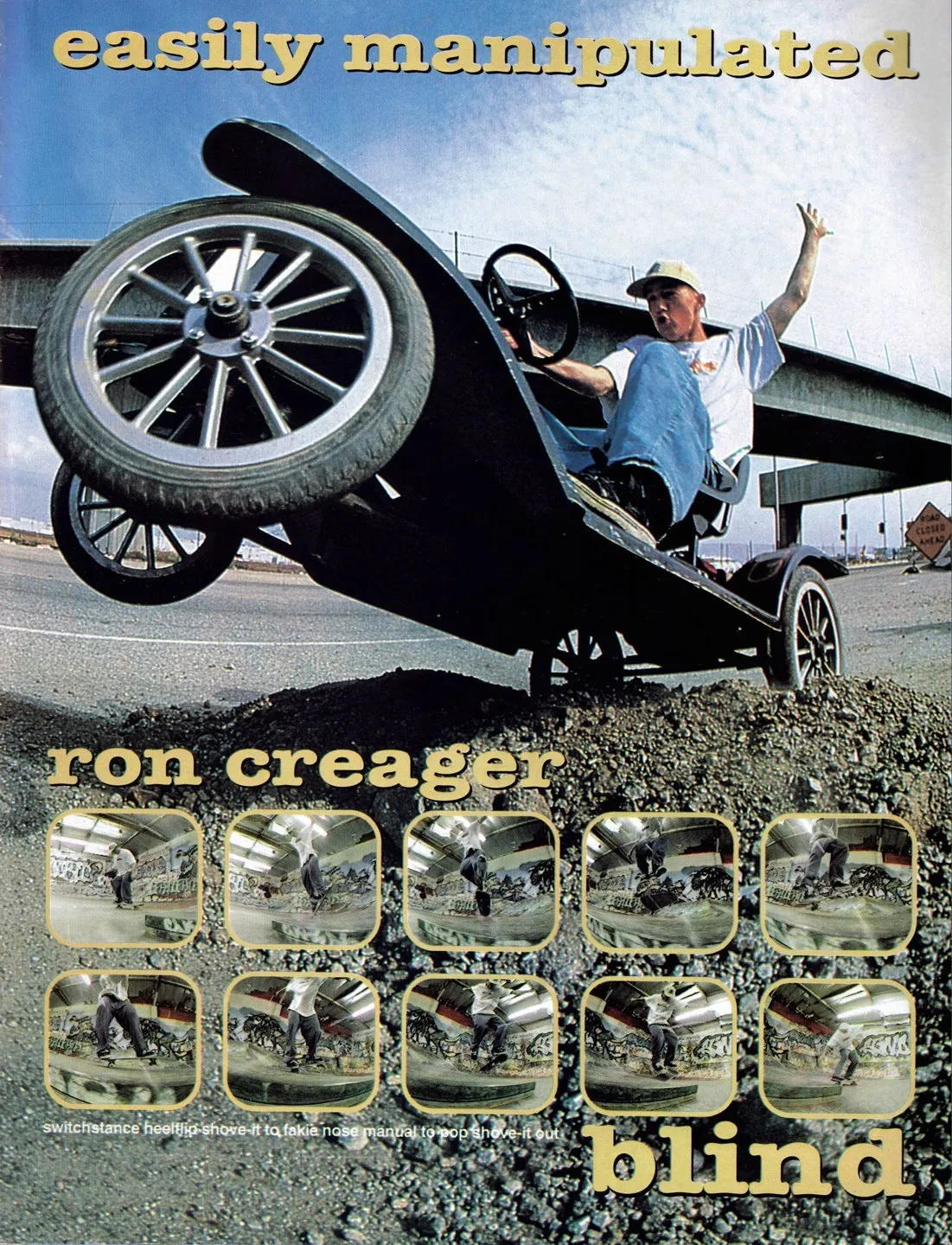
The sequence in that ad is a switch inward heel to manual, shove-it out. The caption calls it a “switchstance heelflip shove it to fakie nose manual.” Switchstance heelflip shove it is fine; I’d assume frontside. But fakie nose manual? How did he get from switch to fakie? It shows how loose trick names have always been. I get really technical about names, but even when it’s weird, you still get what they mean.
Blind, World Industries and 20 Shot Sequence
Now that he was on a World Industries brand, he started showing up in their videos, like 20 Shot Sequence. His part shows mastery of inward heels and nollie hardflips, which were still pretty new. There’s one trick I always thought was an ancestor of the dolphin flip, but in an interview he describes it as a nollie front foot varial underflip. Cool either way. His manual tricks were crazy too. Not many people were on Mullen’s level with that stuff, but these put him right up there. A switch tre nose manual is still hard!
He was extremely loyal to Blind. Blind was in trouble a lot. Girl and Chocolate took a lot of its riders, and at one point he was the only one left on the team. He had chances to move to stronger brands and never took them:
“I got hit up all the time by people who ‘wanted to talk’ but I always tried to be loyal. I wanted Blind to work. It was always my #1 priority, even though they weren’t always my highest-paying sponsor. I don’t like bringing up the money because Blind was always more of a family and a home for me. The money didn’t matter.”
eS, Menikmati and being told to jump down handrails
He didn’t have the same connection with his shoe sponsors. He was on Etnies for a while, then switched to DuFFs. That made sense, since it was a Rocco company and Rodney rode for them, his new family at World. A couple of years later he joined eS, until Menikmati.
Creager has a part in it, but he wasn’t happy with it at all. He says it wasn’t good for reasons out of his control. In some interviews he wouldn’t talk about it; in others he gave a few tidbits. Most of his part was filmed around his hometown while everyone else had footage from all over the world. He had a lot more footage but couldn’t use it because it didn’t go with the music. There seems to be more to it, because not long after the video came out, he and eS parted ways. From his 2001 TransWorld Pro Spotlight:
“They weren’t happy with the way I was skateboarding. I was told at a meeting that I needed to prove myself shoe-worthy and to jump down handrails and stairs to stay on the team. I felt like I was being brainwashed.”
Much later he clarified that they would have kept him on the team, but without his own shoe model. That’s a pay cut and a demotion. For a lot of pros, the shoe is the biggest paycheck.
That interview has a couple of other good details. It took two and a half years to get him to do it, because he kept using the photos for other things instead of letting them stack up for the article. Photographer Seu Trinh finally lied and told him the photos weren’t turning out so he’d leave them alone. He said getting the interview done was like pulling wisdom teeth.
And there’s this question:
What’s the hardest trick you’ve ever tried? I get frustrated with my flatground tricks all the time. That’s a tough one. I usually don’t try it if I think it’s too hard. I’ve had some fun with 720 flips.
People ask me who did the first 720 flip, and I’ve never had a good answer. I still don’t, but I don’t think Ronnie would say he was having fun with them in 2001 if he’d never landed one. I still think someone did it in the 90s, but for now the earliest date I have for a 720 flip is 2001.
Nadia shoes, Arizona and What If
After eS, Ronnie invested in a shoe company called Nadia, which turned out to be a scam.
“Basically, the guy who was in charge of the factory turned out to be sketchy. I had paid for the production of shoes to be made and he ended up taking off. He completely disappeared. So we all just split after that. It sucked. Not that it was all bad; I got to live in China for a while and learn how to make shoes.”
By then his only sponsors were Blind and Tensor, and he moved to Arizona. He says it was because he was worried California would break off and fall into the ocean. Whether that’s the real reason, who knows.
Skating was slow for him then. He was filming for Blind’s What If, struggling to make ends meet and thinking about going back to school. He even joked that his biggest contribution to skateboarding was money, because he was spending $200 a month on bearings without a sponsor! Then Etnies wanted him back, and that got his career going again.
I’m glad, because his What If part is really good. He lands everything so perfectly, even the simple stuff. The filming is good too. In 2005 you still saw a lot of super close-up fisheye, but this is mostly long lens, which was refreshing.
He also won MVP at the Goofy vs. Regular contest that year.
Blind followed What If with The Blind Video, and he had another part. I just really like his skating, and I think it’s the trick selection. The really long nose and tailslides look like a ton of fun, and it’s exactly what I’d be doing if I were as good as him.
Etcetera and leaving Blind
Ronnie stayed with his sponsors a long time. He was on Tensor forever, then switched to Theeve around 2013. In 2011 he started Etcetera, a brand of skateboarding accessories: shoe insoles, ankle stabilizers, wall hangers and that kind of thing.
He’d said:
“I’ve dedicated my whole skate career to Blind and stood behind the company in times of both good and bad but I’m confident that Blind will take care of me.”
That held for a couple more years. In March 2014, Blind announced that they and Ronnie had gone their separate ways. What happened? Here’s a shortened version of what he told Chrome Ball Incident:
“But I had to come to the realization that with the new owners and management, there was no future for me there.
I don’t know exactly what my future was supposed to be there, but I was told several times that when I was done skateboarding, I would have a place to do things. I wanted to believe that I had a home there. But in the end, all they wanted from me was the physical activity of skateboarding. And I’m not going to be able to skate forever.
At one point, I tried running my company Etcetera out of Dwindle as an attempt to get something going but it ended up lingering for about a year or so. I was really serious about it but they didn’t seem to be too interested.
I know that I can’t keep up with these younger guys, I just can’t. But they weren’t allowing me to pursue anything else there. So I had to look out for myself and leave.
I knew that I was getting phased out, but at the same time, I was told I had a home there. So I stayed, until it became obvious that this wasn’t going to be the case. I mean, hell, make me a janitor. That’s fine. Let me learn something and work my way up. Just give me a chance.
It hurt, man. I spent 20 years riding for a company and all of a sudden, I’m worthless. Hopefully I can figure something out.”
That’s rough. He may not have shown much interest in team management or graphics before, but once he really wanted and needed to move on, they kept giving him the runaround.
Where is Ronnie Creager now?
He started a board company called High School Dropout. I saw press releases and announcements, but its online presence wasn’t great. Ronnie said the hardest part was moving into sales instead of just skating. When I made the video, the brand’s old sites were down and its Instagram accounts were empty or private, and I was sure it had gone out of business, until I found ronniecreager.com. That’s where you’ll find the boards, plus stickers, clothes and skate rings, which are spinnable rings that help you come up with trick and combo ideas.
He’s not hard to find otherwise. He’s on Instagram, Twitter and Facebook, and he has a YouTube channel with raw footage and behind-the-scenes clips from his video parts. I recommend checking it out.